Sunday, December 18, 2016

TOW #13 - Visual Text on the Second Great Awakening

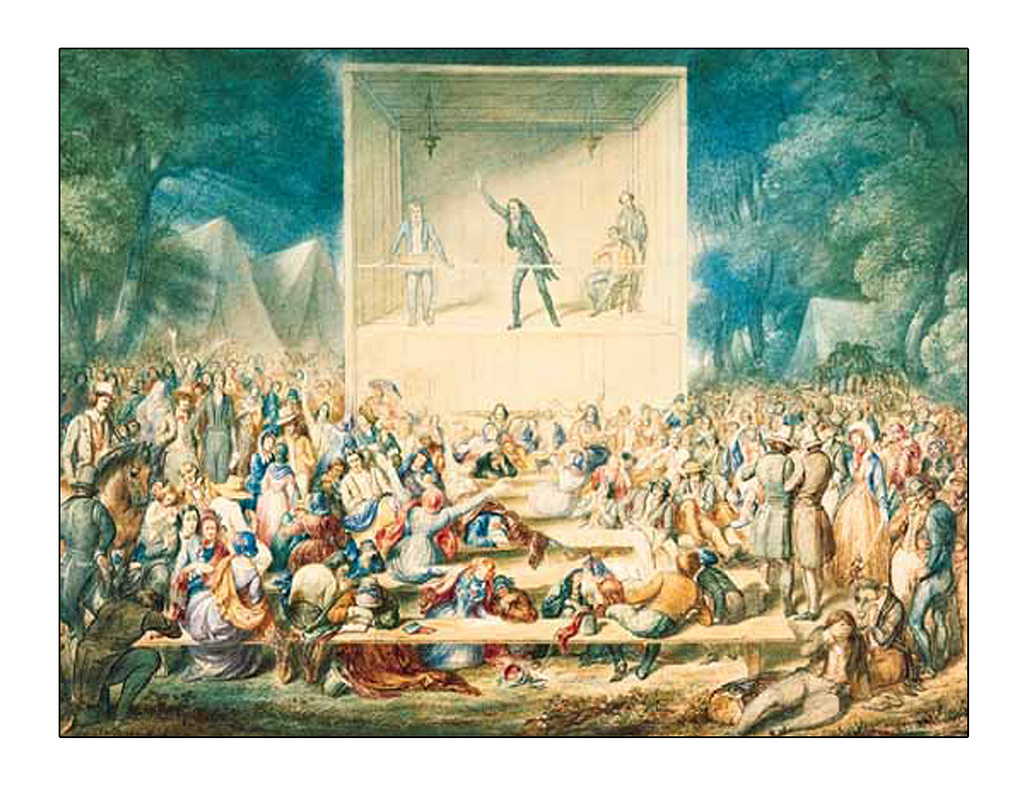
     This portrait was done by an anonymous English artist in 1839 in water color. If examined carefully, this image portrayed many unique things such as a relaxed atmosphere, outdoor location, and mixed gender congregation. Through the artist's use of color and historical accuracy, the artist is able to capture the essence of a camp meeting during the time period of great religious revival in America: the Second Great Awakening.
     The time period is just around the time of the Industrial Revolution, hinting the influence of economic revolution with that of social revolution. In past years, religion had harsh rigid rules that the young people did not like. Due to the climatic changes in economics, many people abandoned this strict interpretation, or religion as a whole. Firm believers became frightened by this and ultimately began the movement for a religious revival. The most notable change in the religion was the image of god as a kind loving father, rather than a strict teacher. 
    This picture is of a North Carolina camp meeting wear traveling priests gave sermons. Many people are gathered, and what is unique to to this mass meeting is that it is outdoors. Using a variety of colors allows for this atmosphere, and further strengthens the significance and beauty of being connected with nature. The relaxed atmosphere went along with the new preaching that human suffering is not required to be let into Heaven. By portraying many females within the crowd, the significance of women in religious sermons can be understood. In actuality, during this time period a vast majority of believers were females.
     Within feet of the crowd are planks, which were referred to as "anxious benches." It is on these crude seats that people confessed their sins in front of a crowd. Men and women would mourn for the poor individual, but also cheer, for their are cleansing themselves of their sins. The historical accuracy of this painting is what has allowed it to be a popular piece of art, even in the 21st century. 

Sunday, December 11, 2016

TOW #12 - IRB Blink by Malcolm Gladwell


This week I continued my reading of Blink by Malcolm Gladwell. In the first half of the book, Gladwell elaborates upon his theories behind "the power of thinking without thinking." Many people before Gladwell had thought about the intricate concepts behind quick-judgments and brash decisions. To gather credible information, Gladwell went to go and visit people for field research. Anecdotes and expert testimonials help to establish his credible, hence persuading his readers to buy into his theories.
Gladwell begins with telling a story about the Getty Museum purchasing a supposedly ancient Greek sculpture, despite being warned that it may be a copy. Many experts advised against this brash decision, yet the Getty Museum put their hopes up and took a bet. Gladwell uses this story to explain how it was not logic that led to quick decisions, but rather "an instinctive sense." All the Getty Museum saw was an old looking sculpture, but one man was able to see in an instant its great value. Gladwell's use of this anecdote allows him to convey the importance of instinct behind decision-making. He also uses this to suggest that not all acts are committed based upon logic, but rather a gut-feeling. " 
     In addition to anecdotes, Gladwell utilizes expert testimonials on establishing his credibility to convey and strengthen his argument: that decision-making is done through a complex process. IN one section, Gladwell discusses about a young couple who came to the University of Washington to be analyzed. John Gottman, a psychologist, recorded their conversations about their dog to determine how long they would be married. John Gottman produced astounding results, discovering that "with a jaw-breaking 90% accuracy" he was able to predict that "the couple would fail to remain married after 15 years." Gladwell's use of expert testimonials is not only engaging to the reader, but also very humorous. Gladwell is able to further convey the importance of past experiences in the process of decision-making, and how that in turn makes behavior predictable.
     Using anecdotes and expert testimonials, Malcolm Gladwell effectively argues the significance of instinct and past experiences behind making decisions. By engaging the audience and establishing his credibility through referencing experts, Gladwell persuades the reader of the complex nature of decision-making. Although I am still in the beginning sections of the book, I have learned a lot about psychology; more specifically, the reasoning behind making decisions. I truly believe that Gladwell is an effective writer in teaching his audience about complex ideas in an easily comprehensible way. 

Sunday, December 4, 2016

TOW #11 - Rhetorical Text "Ain't I a Woman?"

By Sojourner Truth, December 1851

  During the mid 1800's, the abolitionist and suffragette movement was just beginning rise. Growing up through racial and gender inequality, Sojourner Truth grew up in firm belief of equal rights for women. In an 1851 Women's Convention in Akron, Ohio, she argues for a much-needed call for action against gender inequality through her language and use of repetition, so that women can finally be granted their right to vote.
    Truth's tone and diction allows her to further engage and create a deeper level of connection with her audience. She begins her speech by informally addressing her audience with "Well, children, where there is so much racket there must be something out of the kilter." Truth does not pull the typical intelligent and smooth tone with his audience, as many political figures do. She instead directly addresses the audience in a familiar way, making the reader feel compelled to answer as she speaks right to them. Throughout her speech, Truth refrains from using an extensive vocabulary; although, she may just have never learned them. Nevertheless, having an easily comprehensive speech expands her audience, for many people during this time were not excelling literates. By speaking like a common person, she connects with the common people, further strengthening her bond with the audience. brother plight now becomes their common plight, and this newly established connection between reader and writer will help muster the support for fighting gender inequality.
    In addition to her language, repetition of a particular phase allows Truth to emphasize her purpose and draw sentiments from the reader. Truth makes a valid point female stereotypes of the time when she points out that despite nobody and ever helping her into carriages, "Ain't [she] a woman?" She can "eat as much as a man...and bear the lash as well! And ain't [she] a woman?" Truth behaves and possesses the strength that is often accredited to men, and yet she is not given the same rights as men. She works just as hard and has fought just as hard as men, but because she is a woman she is not granted equality. Because the phrase is constantly repeated throughout her speech, it remains in the thought of the reader to mull and take action on. Her cry makes the reader pause and consider the double standards of female stereotypes. The readers will grow empathetic to other women whose efforts will never be recognized. Their efforts appear vain when no matter how much effort they put in, they will only be seen as a woman desperately cry out "Ain't I a woman?"
    In combatting the issues of female equality of the 1800's, Sojourner Truth argues for the rights of women in hopes of persuading her audience to act upon her words. She develops this argument with her vivid language and repetition of the phrase "ain't I a woman?," effectively engaging the audience's sentiments and making a convincing point about the rights of women. If men allow for the women to take upon the rightful places in society and the freedom that comes with it, these women will surely "get it [the world] right side up again!"

Sunday, November 20, 2016

TOW #10 - "God Weirded Out By Christian Who Loves Him After Only Month In Church"

The Onion 

    In this satirical article from the Onion, the author writes about the now severed ties between God and devout Christian, Christian Dale Evans. The author includes quotes from an interview with God and a sarcastic/sardonic tone to poke fun at people who proclaim themselves at devout worshippers of God despite only following him for a short amount of time.     

Christian Dale Evans came across God just one month ago. The Divine Creator, God himself, responded to this as a "super creepy" situation. "He's only gone to services for three or four Sundays now, and yet he's already trying to talk to me every night and telling all his family and friends about how great I am--It's kind of unsettling," God told the Onion. Obviously, God did not come down to talk to the Onion and tell them that this man was creeping him out. However, by being sarcastic in ridiculing this "Christian who came to love God in only one year," the Onion illustrates the ridiculousness of people who claim to be a devout believer after years of not really caring for religion. When the Onion asked God about how he would deal with this situation, he said that he didn't need "another toxic relationship with a f*cked-up Christian." Evans reportedly did not take any time to get to know Him before he claimed that he wanted to be with God forever, and that was upsetting to God. Likewise, if someone in today's world practiced Christianity for one month and then went to confess his/her love for him, God would cut all ties. "A little admiration here and there is okay," but going from zero to 6o in the blink of an eye" will only make His skin crawl.     


 By including quotes from God, the author is able to add to the humor of this article. However, his sardonic and sarcastic tone acts as criticism of the issue at hand; people "going from zero to 60 in the blink of an eye." Both of these rhetorical devices  help in bringing light to this issue in hopes of having readers realize the ridiculousness of this situation. 

IRB Intro Post #2 - Blink By Malcolm Gladwell

Blink by Malcolm Gladwell

     For my second IRB, I chose Blink by Malcolm Gladwell. He is a critically acclaimed author and psychologist who had his book The Tipping Point become a bestseller. This fascinating book revolves around the concept of thinking without actually thinking; the decision people people make or actions done without much thought. It goes in depth behind the reasons why some people become brilliant decision-makers, while others struggle to make even the simplest choice. He discusses about how our brains work and how that ties into the decision-making skills of people. A very interesting theory he proposes is the art of "thin-slicing - filtering the very few factors that matter from an overwhelming number of variables." A couple years ago I came across Malcolm Gladwell's book Outliers and thoroughly enjoyed myself. I remembered seeing Blink  in my father's bookshelf, and seeing that I enjoy his books I thought I would give this one a try.

Sunday, November 13, 2016

TOW #9 - Clinton Supporters React to Election Results

A Devastating Loss for Clinton Supporters
     This image was taken moments after the voting results were announced at Hillary Clinton's election night event at the Jacob K. Javits Convention Center on November 8, 2016 in New York City. Photographer Drew Angerer effectively captured the fear of the American citizens who would become victims of America's political system with Donald Trump as president. Angerer chose to focus not on one specific individual, but a whole diverse group of people: white women, colored women, colored men: all of whom are devastated by the outcome. This image which showcases the fear on every body's faces and a diverse group of people effectively convey to the audience about how a great deal of people feel towards our new President. 
     Throughout Trump's campaign for presidency, many racial and sexist slurs have been brought about. With scandals being uncovered about his mistreatment of women, tensions have been increasingly high days before the election. These high tensions brought about great emotional stress, and when the results were in, people broke. All of the people in this photograph are seen undergoing some sorts of emotional distress, whether they be signing in resignation or crying in heartache. It is not just the facial expressions that are important hear, but also the sheer number of people with this look of dismay. By highlighting a group of upset people, rather than a single individual, the photographer can get across the idea that many people are unhappy. Ironic how the happiness of the people is something that the U.S. prides them self in upholding. 
     By targeting minority figures in the U.S., Trump has created a great amount of enemies amongst members of the female and non-white community. Many of the promises he made during his campaign would bring disastrous consequences upon these people. Those who feared him fought desperately alongside Clinton, but when the results came in, all realized the fate that awaited them. Amongst the people photographed, more than half are women or colored. The photographer's decision to showcase people of many different races allows his audience to see the reactions of those who will become oppressed under his rule. Angerer is not sharing the fear of the white privileged males, but instead of the females and racial minorities. 
     The spotlight is put upon a great many of people who share two common characteristics: fear and being of a racial/gender minority. With knowledge of Trump's candidacy, all were frightened and could only watch with horror as their new President was inaugurated. They knew that Trump would not make America great again; at least, not for them. 

Sunday, November 6, 2016

TOW #8 - IRB: "They Poured Fire on Us From the Sky"

Benson Deng, Alephonsion Deng, and Benjamin Ajak

     The journey of the three Lost Boys of Sudan continues in They Poured Fire on Us From the Sky. After years of separation, the brothers and their cousins are finally reunited in a rebel camp. However, their harrowing experiences have yet to cease as death remains a commonality in their daily life. This book serves to honor those who died by this conflict that the adults who dragged the innocent into the war. The extent of their horrors are effectively portrayed by their use of diction. 
     Throughout this memoir, Alepho, Benson, and Benjamin take turns in recounting their individual experiences. Because they were all of a very young age, the details and the diction they use to share their experiences have an air of innocence that sharply contrasts with the brutality they discuss. For example, when the youngest boy Benjamin recalls the time he and the other refugees were forced into the Gilo by the Ethiopian government troops, "whether or not you could swim you had to dive into that water. Even if you could swim, a lot of people stepped on you. Many people died. [His] leg wound was so bad, but the Lord God helped [him]" (145). This boy is talking about being stomped to death or being shot. But he so simply tells it because as a child, it would have been difficult for him to fully comprehend the situation. All he could understand was that people were dying, and he had to pray for survival. The diction that he uses is very limited and not particularly sophisticated, but it effectively emphasizes his innocence in contrast to the brutality that he experienced at such a young age. Although there is no figurative language that provides the reader with a context to form a visual, the innocence emanating from the boy is enough to show how horrific the event was. 
      Every moment the boys encounter a dangerous event, the reader will cringe at how horrific of an experience they had, especially at such a young age. Because of the war conflict the boys were separated and then reunited many times. There heartfelt story tells war from the side of the children, the innocent, who had no say in the war plaguing their lives. They could only fight for their survival and hope to God that their lives would turn for the better.